How Long Does a Vehicle Wrap Last in the Texas Sun?
But we live in Texas, and that matters.
Amarillo vehicles deal with intense sunshine, heat, wind, dust, sudden temperature changes, and plenty of unpredictable West Texas weather. A vehicle that spends every day outside in direct sunlight may wear differently than one that is regularly garaged or parked under cover.
UV exposure is particularly important because prolonged exposure to sunlight can eventually affect vinyl.
That doesn’t mean a wrap isn’t a good choice in Texas. It means the quality of the material, installation, and care all matter.
Once you leave the shop, you have a part to play too. Regular cleaning, avoiding harsh chemicals, and addressing contaminants quickly can all help protect your wrap.
Will a Vehicle Wrap Damage My Paint?
This is one of the biggest concerns people have before wrapping a vehicle.
Generally, a professionally installed and properly removed wrap shouldn’t damage factory paint in good condition.
But there is an important part of that sentence: the condition of the paint before the wrap goes on.
Vinyl isn’t a repair for damaged paint.
If a vehicle already has peeling paint, rust, failing clear coat, poorly repaired bodywork, or a previous paint job that isn’t properly bonded to the vehicle, those existing problems can affect the wrap and what happens when it is eventually removed.
That’s why it’s important to check the vehicle’s condition before wrapping.
If you’re worried about your paint, bring the vehicle by and let the 777 Wraps team take a look. We’d rather talk about an existing issue before installation than discover it after the fact.
Is It Better to Wrap a Vehicle or Paint It?
It depends on what you’re trying to accomplish.
A paint job permanently changes the finish of the vehicle. A wrap gives you the ability to dramatically change its appearance while maintaining the option to remove or change the wrap later.
For a business, flexibility can be even more important.
Logos get updated. Phone numbers change. Services change. A truck may be sold. A company may rebrand.
A commercial wrap allows the vehicle to become part of the company’s branding while still giving the business options down the road.
There’s also a big difference between simply changing a vehicle’s color and creating a commercial wrap designed to advertise a business. That’s why the conversation should begin with what you want the vehicle to do for you, rather than simply asking whether a wrap or paint is “better.”
You have several options.
A full wrap covers most or all of the vehicle’s painted surfaces and gives the designer the greatest freedom to transform its appearance completely.
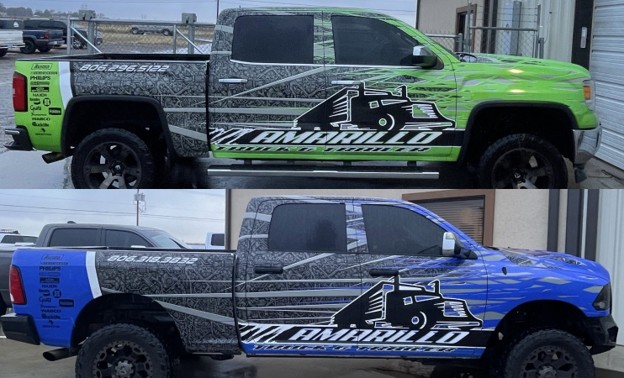
A partial wrap uses strategically selected areas of the vehicle. For a commercial vehicle, the existing paint color can actually become part of the design.
Decals, lettering, and custom graphics also work when a complete or partial wrap isn’t necessary.
For a business owner, a great design doesn’t necessarily mean covering every square inch of the vehicle. The goal should be to make the business easy to recognize and the message easy to understand.
Someone driving behind your truck shouldn’t have to study it for five minutes to figure out who you are.
Sometimes less really is more.
Are Vehicle Wraps Worth It for a Local Business?
Think about how many places your work vehicles already go during a normal week.
They drive through neighborhoods. They sit at stoplights. They park at customers’ homes. They travel between jobs. They sit in parking lots.
A commercial vehicle wrap turns something your business already owns and operates into another place for people to see your brand.
The vehicle can display your company name, logo, services, website, and phone number while you’re doing the work you were already going to do.
For a local company, there’s another advantage: the people seeing that vehicle are often the same people the business wants to reach.
If you’re an Amarillo service company and your wrapped truck is parked in an Amarillo neighborhood, the people driving past aren’t random impressions from across the country. They’re people who live and work in your market.
A strong commercial wrap also helps create recognition.
That’s especially important when you’re wrapping an entire fleet.
What Makes a Good Commercial Vehicle Wrap?
A commercial wrap needs to look good, but looking good isn’t enough.
It needs to communicate quickly.
Think about how people actually encounter a wrapped vehicle. They may see it for only a few seconds at a traffic light or as it passes them on the road.
That means the most important information needs to be obvious.
Who are you? What do you do? How can someone reach you?
A company logo that is too small, a phone number buried in the design, or ten different services competing for attention can make an expensive wrap much less effective.
The vehicle itself matters too. The design has to account for doors, windows, wheel wells, handles, body lines, and other features.
That’s why custom design matters.
Can You Wrap an Entire Business Fleet?
And when you’re wrapping multiple vehicles, consistency becomes especially important
Your trucks or vans don’t necessarily have to be identical models to look like they belong to the same company.
Consistent colors, logos, typography and placement can create a recognizable look across the fleet.
That means whether someone sees Truck #1 on Monday or Van #6 two weeks later, they still recognize the same company.
For growing Amarillo businesses, establishing those standards early can also make it easier to add additional wrapped vehicles as the fleet grows.
How Should You Take Care of a Wrapped Vehicle?
A little maintenance can make a big difference.
Wrapped vehicles should be cleaned regularly so dirt, insects, bird droppings, and other contaminants aren’t allowed to sit on the vinyl for long periods of time.
That’s particularly important when contaminants are combined with the Texas sun.
Gentle washing is generally preferable to aggressive cleaning methods. Avoid abrasive brushes and harsh chemicals that aren’t appropriate for automotive vinyl.
If you aren’t sure whether a particular cleaner, wax, automatic car wash or detailing product is safe for your wrap, ask first.
And if you can park the vehicle in a garage, under a carport or in the shade when practical, reducing prolonged UV exposure can help too.
A wrap is an investment. Treating it like one can help keep it looking good longer.
Sometimes—but this is another situation where seeing the vehicle matters.
Vinyl conforms to the surface underneath it. It isn’t body filler, and it won’t magically make a dent disappear.
Minor imperfections may not prevent a vehicle from being wrapped, but significant dents, rust, peeling paint or failing clear coat may need to be addressed first.
That’s another reason we don’t believe in giving every customer the exact same answer over the phone.
Bring the vehicle in. Let us look at it.
Then we can tell you what makes sense.
Why Professional Installation Matters
You can buy vinyl online.
That doesn’t mean every wrap is the same.
Proper vehicle preparation is important because the vinyl needs a clean, appropriate surface. Installation technique matters around curves, edges, recesses, seams, and other complicated areas of the vehicle.
777 Wraps says it installs wraps indoors in a climate-controlled facility, and its installers hold 3M and Avery certifications.
Those are exactly the kinds of questions you should ask when you’re comparing wrap companies—not simply, “Who gave me the lowest price?”
Ask what materials they use. Ask where they’ll wrap the vehicle. Ask to see their actual work. Ask about care. Ask what happens if you have a problem.